Islamic Studies for Children Online — Age-Wise Curriculum Guide
27 May 2026 · Thazqu Super Admin
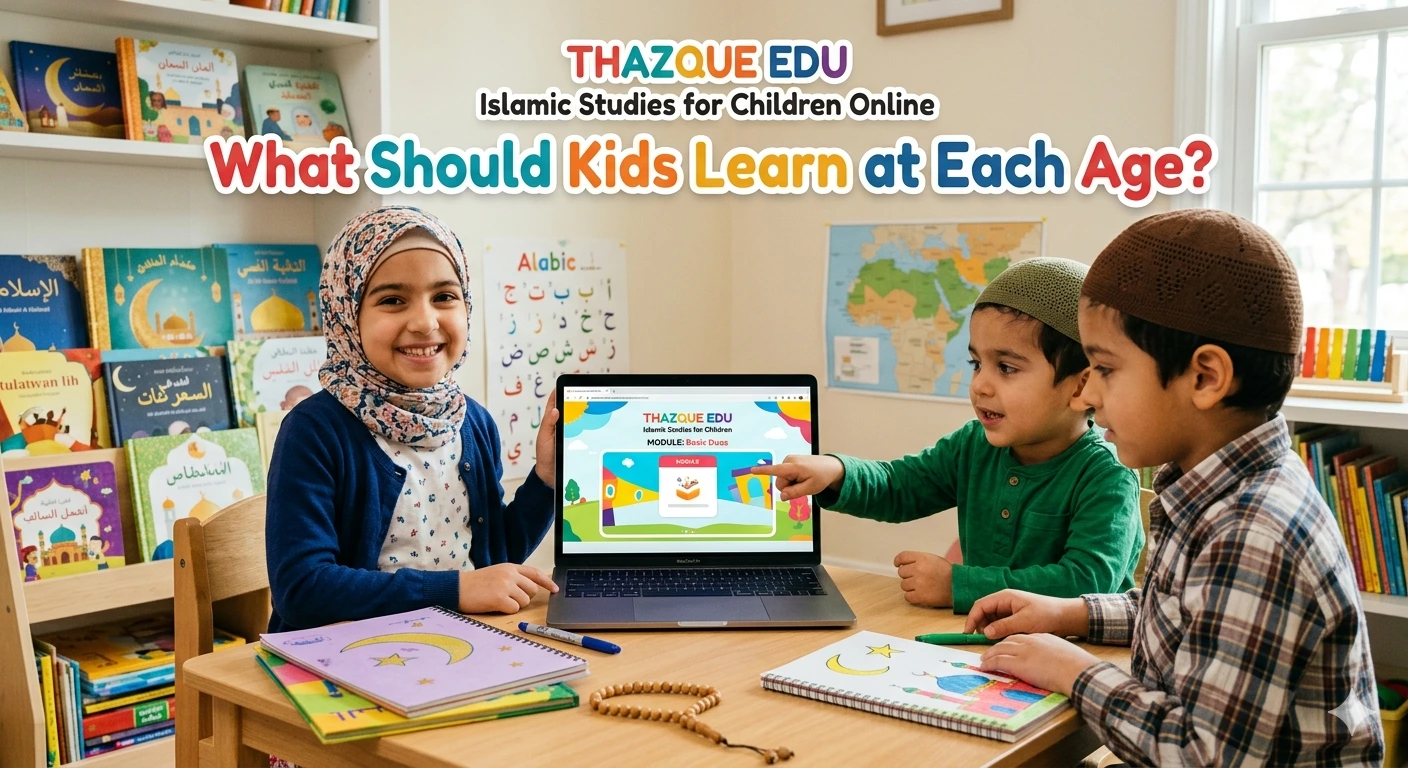
Every Muslim parent wants their child to grow up with strong Islamic values. But one question comes up again and again in Kerala homes and Gulf family groups:
"Where do I even start? And what should my child be learning right now?"
The truth is, Islamic education isn't one-size-fits-all. A 5-year-old and a 12-year-old need completely different lessons — in content, in method, and in depth.
This guide breaks down exactly what Islamic studies for children should cover at each age group, and how structured online classes can make it easier for parents — whether you're in Kerala or anywhere in the Gulf.
Why a Structured Islamic Curriculum Matters for Kids
Many children learn Islamic content in scattered ways — a dua here, a story there. Without a proper sequence, gaps form. Children reach their teens without understanding basic fiqh, or they can recite Surah Al-Fatiha but don't know what it means.
A structured curriculum ensures:
- Every foundational topic is covered in the right order
- Learning builds progressively from one year to the next
- Children stay engaged because lessons match their age and understanding
- Parents can track actual progress — not just Quran recitation
At Thazque Edu, every child follows a personalised learning path built around their current level, not just their age.
Ages 4–6 — The Foundation Stage
What children are ready for at this age:
At 4–6, children absorb through repetition, rhyme, and stories. They don't yet reason abstractly, but they retain what they hear and see every day.
What Islamic lessons should cover:
- Arabic letters and sounds — recognising the 28 Arabic alphabet letters with correct pronunciation
- Basic duas — Bismillah, dua before eating, dua before sleeping, dua for parents
- Kalimah Tayyibah — introduction and meaning in simple language
- Stories of the Prophets — Ibrahim (AS), Nuh (AS), and the Prophet Muhammad (SAW) through age-appropriate narration
- Names of Allah — starting with Ar-Rahman and Ar-Raheem
- Adab (manners) — saying salaam, respecting elders, being kind
How Thazque Edu approaches this stage:
Classes at this level use visual aids, short storytelling sessions, and repetition drills. Sessions are kept to 20–25 minutes to match a young child's attention span.
Ages 7–9 — Building the Basics
What changes at this stage:
Children at 7–9 begin to understand cause and effect. They can memorise longer content, follow logical explanations, and start developing a personal relationship with their faith.
What Islamic lessons should cover:
- Quran reading — moving from letters to joining words, short surahs with tajweed basics
- Salah — full salah sequence, meaning of each step, why Muslims pray five times a day
- Pillars of Islam and Iman — explained at their level with examples
- Seerah introduction — the birth of Prophet Muhammad (SAW), life in Makkah, key events
- Duas — expanding the repertoire: dua before and after wudu, travelling, rain
- Akhlaq lessons — honesty, gratitude, controlling anger — using Quran and hadith stories
For Gulf and NRI families:
This is typically the age where children are fully immersed in the school systems of the UAE, Qatar, or Saudi Arabia and may have limited exposure to Islamic teaching class compared to peers back in Kerala. Online classes with a structured weekly timetable fill this gap without disrupting school schedules.
Ages 10–12 — Building Understanding
What shifts at this stage:
Pre-teen children start asking "why." They want reasons, not just rules. This is the most important window for grounding their Islamic identity before teenage years begin.
What Islamic lessons should cover:
- Tajweed rules — makharij, rules of noon sakinah and tanwin, medd, qalqalah
- Fiqh basics — taharah (purification), salah in detail, fasting rules, what breaks wudu
- Seerah in depth — life in Madinah, battles, key companions (RA), lessons from the Prophet's character
- Memorisation — Surah Yaseen, Al-Mulk, or selected surahs based on progress
- Islamic history — Khulafa-e-Rashideen, spread of Islam, key civilisational contributions
- Understanding halal and haram — not just lists, but the wisdom behind them
How Thazque Edu structures this:
One-to-one sessions allow the teacher to challenge a child who is ahead and support one who is behind — without either child feeling rushed or left out. This is one area where group madrasah settings often fall short.
Ages 13 and Above — Deepening and Owning Their Deen
What Islamic education should look like for teenagers:
Teenagers need to move from inherited faith to understood faith. If they can't explain why they believe what they believe, peer pressure and social media become serious risks.
What Islamic lessons should cover:
- Aqeedah — Tawheed in depth, understanding shirk, attributes of Allah
- Advanced fiqh — zakat, marriage rules, business ethics in Islam
- Quran with tafseer — understanding context, reasons for revelation, applying lessons
- Seerah as life guidance — how the Prophet's decisions apply to modern life
- Da'wah and Islamic ethics — how to discuss Islam confidently and respectfully
- Arabic language basics — understanding common Quranic vocabulary
The goal at this stage is not just knowledge — it's conviction.
Not sure which level is right for your child? Thazque Edu's teachers assess every child before the first class — so your child starts exactly where they should. No guesswork, no wasted sessions. 📲 WhatsApp us now to book a free assessment class.
What About Children Who Are Behind?
Some children — especially those who moved abroad young or grew up in non-Muslim majority environments — may be 10 years old but reading at a 6-year-old's Islamic level. This is far more common than parents admit.
At Thazque Edu, this is never a problem. Classes are structured around the child's current level, not their school grade. Progress moves at a pace the child can handle, with encouragement rather than comparison.
How Thazque Edu Delivers Islamic Studies for Children
One-to-one classes — your child gets the teacher's full attention, every session
Qualified teachers — trained in both Islamic curriculum and child-friendly teaching methods
Malayalam and English medium — lessons delivered in the language your child is most comfortable in
Flexible scheduling — morning, evening, or weekend slots to suit school timetables
Regular progress updates — parents receive updates so you always know where your child stands
Free trial class — start with no commitment
Islamic education isn't just something children receive at madrasah and forget by dinnertime. When it's taught well — at the right level, with the right method, by a teacher who genuinely engages them — it becomes part of how a child sees themselves and the world.
Thazque Edu exists to make that quality of teaching accessible — for every Muslim child, wherever they are.
Start structured Quran learning with Thazque Edu
Explore live online Quran classes, Tajweed lessons, and Madrasa programs designed for children and adults.