Online Quran Classes for Teenagers — Keeping 13 to 17 Year Olds Engaged | Thazque Edu
19 May 2026 · Thazqu Super Admin
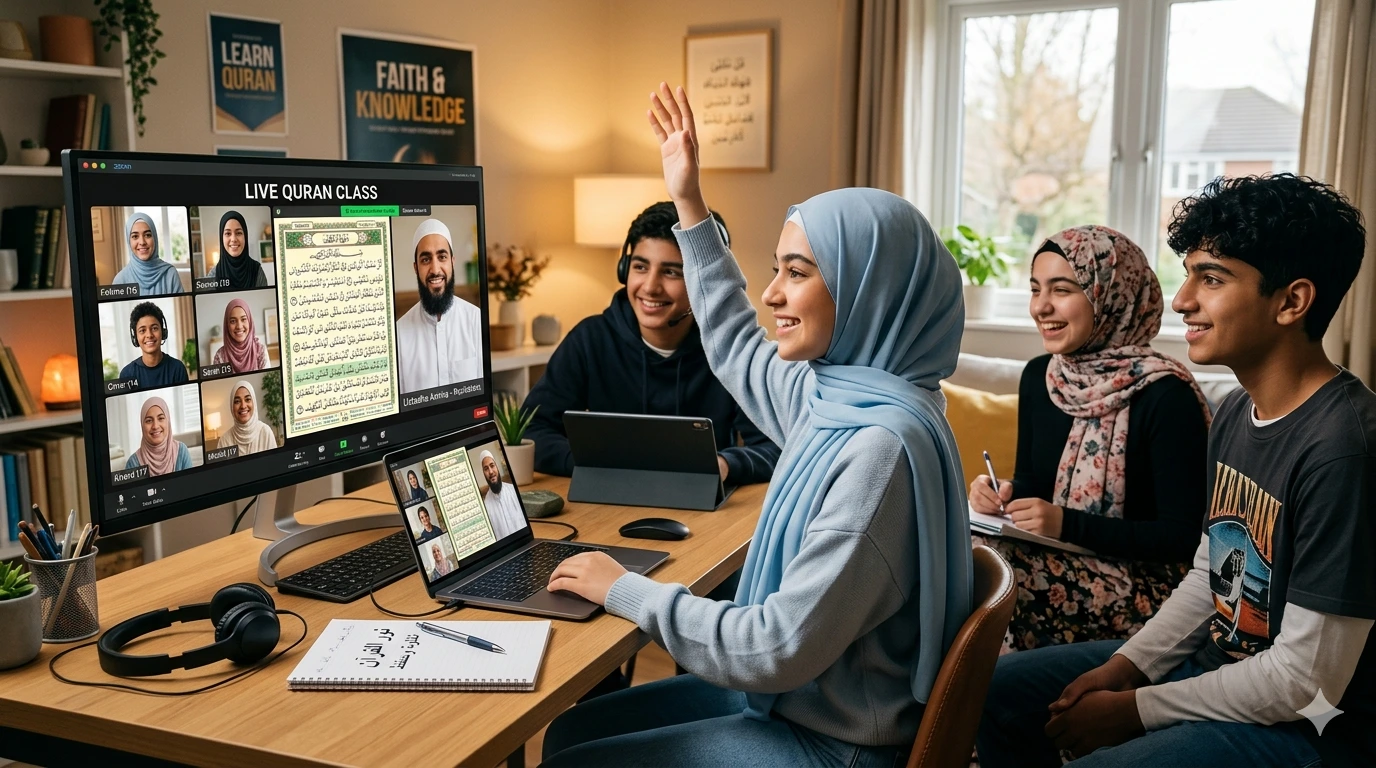
Online Quran Classes for Teenagers — How to Keep 13 to 17 Year Olds Engaged in Learning
Your child learned the Arabic alphabet at age six. They completed Qaida by eight. They were reading short surahs confidently by ten.
And then — somewhere between Class 8 and Class 10 — everything slowed down.
Board exam pressure arrived. Social life became complicated. Phones became a permanent fixture. And Quran learning, once a daily habit, became the first thing skipped when life got busy.
If this sounds familiar, you are not alone. This is one of the most common and most painful patterns Muslim parents face — and it has nothing to do with your child's faith or your parenting.
It has everything to do with understanding the teenage mind.
This blog explains why teenagers disengage from Quran learning, what actually works to bring them back, and how structured online Quran classes for teenagers can be the turning point — even for teens who have resisted every previous attempt.
Why Teenagers Are Different From Younger Learners
Everything that works for a seven-year-old in Quran class fails completely with a fifteen-year-old.
Young children respond to repetition, rewards, and a warm teacher voice. Teenagers respond to relevance, autonomy, and respect.
A teenager who feels talked down to in class will mentally check out within minutes — even if they are physically present. A teenager who feels their time is being wasted will find a reason to miss the next session.
This is not bad character. This is developmental psychology.
Between ages 13 and 17, young people are:
- Building their own identity and questioning inherited beliefs
- Under significant academic pressure from school and competitive exams
- Navigating peer relationships and social comparison
- Spending more time on screens than any previous generation
- Craving autonomy and resisting anything that feels imposed on them
A Quran class that ignores all of this — and treats a 16-year-old like a 6-year-old — will fail. A class that understands this stage of life and works with it will succeed.
👉 See how Thazque Edu's online Quran classes are structured for different age groups
The Real Reasons Teenagers Disengage From Quran Learning
Before solving the problem, it helps to name it clearly. Teenagers disengage from Quran learning for specific, predictable reasons:
1. They feel behind and embarrassed Many teenagers compare their recitation to peers who had more consistent early education. Feeling behind creates shame, and shame creates avoidance.
2. Classes feel childish or irrelevant Group madrasa settings or classes designed for young children feel beneath a teenager's dignity. If the teaching style does not match their age, they will not engage.
3. Academic pressure wins every scheduling conflict When Class 10 board exams approach, anything that is not on the mark sheet gets deprioritised. Parents accept this trade-off reluctantly, and the habit breaks.
4. No personal connection with the teacher Teenagers need a teacher they respect — someone who talks to them like an intelligent young adult, not a child being corrected. Without that connection, learning stops.
5. Fixed timing clashes with their actual life School, tuition, sports, and social commitments make rigid schedules nearly impossible for teenagers. One clash leads to a missed class, which leads to another, which leads to complete discontinuation.
What Actually Works for Teenage Quran Learners
Here is what the research on adolescent learning — and the experience of qualified Islamic educators — consistently shows:
One-to-one attention over group settings Teenagers learn better when they are not being watched or judged by peers. A private one-to-one class removes the embarrassment factor entirely and lets the student ask questions they would never ask in a group.
A teacher who explains the why, not just the what Teenagers want to understand. Why does Tajweed matter? What does this surah actually mean? What is the wisdom behind this rule? A teacher who answers these questions builds genuine connection with the Quran — not just mechanical recitation.
Flexible scheduling that respects their academic calendar During exam season, reduce frequency. After exams, build back up. A rigid platform that does not accommodate real life will lose teenage students every single time.
Progress they can see Teenagers are motivated by measurable achievement. Clear milestones — completing a Juz, mastering a Tajweed rule, memorising a surah — give them something to work toward and feel proud of.
Respect and autonomy in the learning process Letting the student have some say in what they focus on — whether that is a particular surah they want to memorise, or understanding the meaning of what they already recite in Salah — increases ownership and motivation dramatically.
📲 Is your teenager struggling to stay consistent in Quran learning? WhatsApp us to book a free demo class — no pressure, no commitment.
How Online Quran Classes Solve the Teenage Learning Problem
Online Quran classes for teenagers are not just a convenience — for this age group, they are often the best possible format.
Here is why:
No commute, no peer judgment Teenagers do not have to sit in a madrasa classroom next to younger children or peers who are more advanced. Learning happens in their own space, on their own terms.
Scheduling around board exams and school Online platforms can adjust timing week by week. During Class 10 or Class 12 exam months, sessions can be reduced to once a week without losing the habit entirely. After exams, full schedule resumes.
Access to the right teacher, not just the nearest teacher Geography no longer limits who teaches your child. A teenager in Kerala, in Dubai, or in any city can access a certified Quran tutor who is specifically experienced in teaching adolescents.
Technology feels natural to them Teenagers are native digital users. Online classes — with screen sharing, audio feedback, and digital Quran tools — feel native to how they already learn and communicate.
Privacy for adults in progress Many 16 and 17-year-olds are more adult than child. A private online class honours that. They can ask questions about meaning, about Islamic studies, about things they are genuinely curious about — without an audience.
👉 Learn how Thazque Edu structures online Quran classes for teens and adults
Balancing Board Exams and Quran Learning — A Practical Guide for Parents
This is where most families struggle the most.
Class 10 and Class 12 are high-stakes years. Parents feel guilty pushing Quran class when their child has five subjects to study for board exams. Teenagers use exam pressure as a legitimate reason to pause — and the pause becomes permanent.
Here is a practical framework that works:
During exam preparation months (2–3 months before boards):
- Reduce online Quran classes to one session per week
- Focus only on revision of what is already learned — no new content
- Keep the habit alive even at minimum frequency
During exam month itself:
- Keep one short session per week if possible — even 20 minutes
- Focus on recitation the student already knows — builds confidence, not pressure
- Frame it as a source of calm and barakah, not another task
Post-exam:
- Resume full schedule immediately — do not let the gap extend
- Set a new goal for the next three months — a Juz to complete, a surah to memorise
- Celebrate the return to learning
The key principle: never fully stop. A break in habit is recoverable. A complete stop for months is very difficult to reverse, especially in teenagers.
Islamic Studies Alongside Quran Learning — Why Teenagers Need Both
Many teenagers who are mechanically reciting Quran have no idea what they are reading.
They can read Surah Al-Mulk with correct Tajweed but cannot tell you what it means or why the Prophet ﷺ recommended reciting it every night.
This disconnect is a major reason teenagers lose motivation. Recitation without understanding feels like a pointless exercise to an intelligent 15-year-old.
Islamic studies for teenagers — integrated alongside Quran recitation — changes this completely.
When a teenager understands:
- The meaning and context of the surahs they are memorising
- The stories of the Prophets connected to what they are reading
- The wisdom behind Tajweed rules and the preservation of the Quran
- How Islamic values connect to real decisions they face in their daily life
— Quran learning becomes meaningful, not mechanical.
At Thazque Edu, tutors are trained to integrate Quranic understanding alongside recitation, making the learning experience relevant to a teenager's actual life and questions.
For NRI and Gulf Families — Keeping Your Teenager Connected to the Quran Abroad
This section is especially important for Muslim families living outside India.
Teenagers growing up in the Gulf, UK, or other countries face additional challenges:
- Limited access to a qualified local Quran teacher
- Peer environments that do not prioritise Islamic education
- Cultural pressure to assimilate that can quietly erode religious habits
- Parents working long hours with limited time to supervise religious education
Online Quran classes for teenagers solve every one of these challenges.
Your child can learn from a certified, Malayalam-speaking or English-speaking tutor from the comfort of home — with timing that fits Gulf or international time zones. No compromise on quality. No geographic limitation.
Many NRI families tell us that consistent online Quran education has been one of the most important factors in their teenager maintaining Islamic identity and values while growing up abroad.
📲 Are you an NRI parent looking for consistent Quran education for your teenager? WhatsApp us now — we will find the right tutor and timing for your family.
What to Look for in an Online Quran Academy for Teenagers
Not every online Quran platform is equipped to teach teenagers well. Here is what to check before enrolling:
- Age-appropriate teaching approach — does the tutor understand adolescent psychology or do they use the same methods for all ages?
- Certified in Tajweed — recitation quality must be non-negotiable
- Demo class available — your teenager should meet the tutor before committing
- Flexible rescheduling — especially important for board exam periods
- Integration of meaning and Islamic studies — not just mechanical reading
- Same-gender tutor option — important for teenage girls especially
- Consistent tutor — changing tutors frequently breaks the relationship and learning momentum
👉 See how Thazque Edu meets every one of these standards — explore our online Quran classes
Final Thoughts — The Best Time to Restart Is Now
Teenage years are not lost years for Quran learning. They are actually some of the most impactful years — because what a teenager internalises between 13 and 17 stays with them into adulthood.
The right class, the right tutor, and the right approach can turn a resistant 14-year-old into a confident, consistent Quran learner.
Do not wait for the perfect moment. Exam seasons will come every year. The right time to restart — or start properly for the first time — is now.
📲 Book a free demo class for your teenager today. Message us on WhatsApp — we will match your child with the right tutor within 24 hours.
👉 Explore all online Quran classes at Thazque Edu — for kids, teens, and adults
Start structured Quran learning with Thazque Edu
Explore live online Quran classes, Tajweed lessons, and Madrasa programs designed for children and adults.